
Houston Launches First Comprehensive LGBTQ Community Survey
L.O.V.E. Survey aims to gather 5,000 responses regionwide.

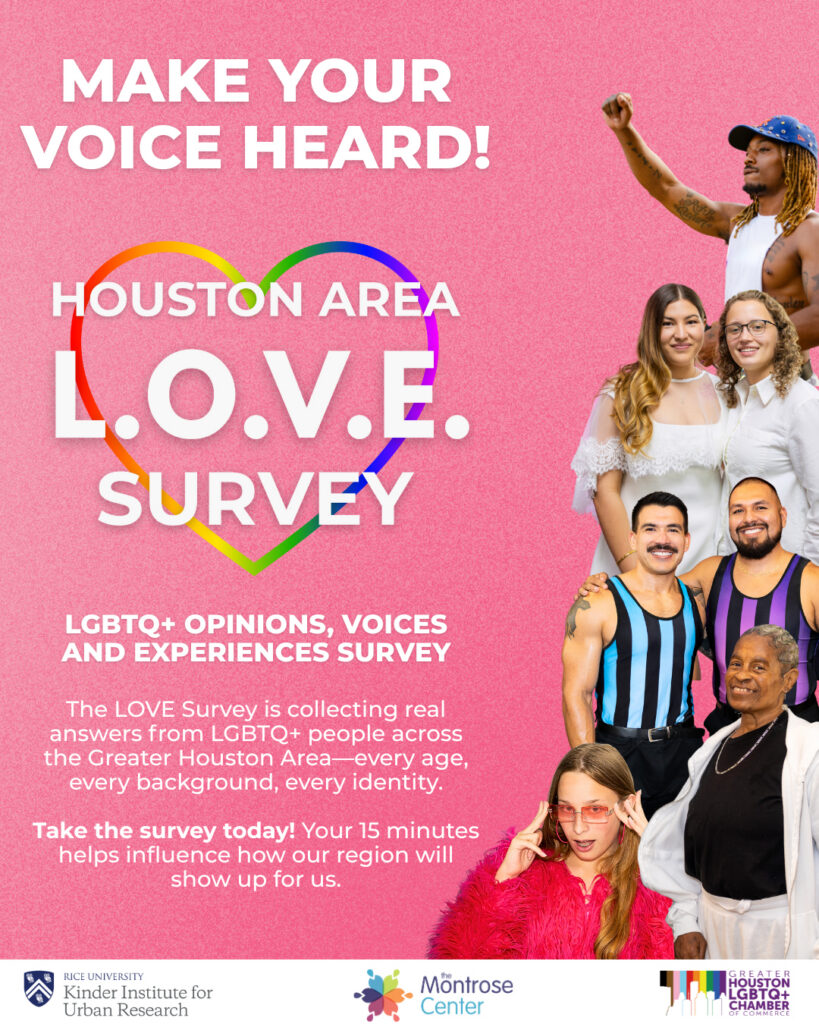
For decades, LGBTQ Houstonians have organized, built institutions, supported one another, and advocated for change. But despite that long history of activism and community leadership, one thing has been missing: comprehensive local data about LGBTQ life across Greater Houston. This February, that began to change.
Launched at the 2026 Greater Houston LGBTQ+ Community Summit, the Houston Area L.O.V.E. Survey is the first large-scale, community-driven effort to document the lived experiences of LGBTQ adults across the region. Organizers say the project represents a critical next step in strengthening advocacy, improving services, and ensuring that LGBTQ voices are reflected in policy decisions that shape everyday life.
The L.O.V.E in the survey’s name stands for LGBTQ Opinions, Voices, and Experiences. Its goal is ambitious but clear: gather responses from at least 5,000 LGBTQ adults living in Harris, Fort Bend, Montgomery, Galveston, Brazoria, Chambers, Liberty, and Waller counties.
“There’s no existing dataset that really reflects the full lives of LGBTQ+ people here,” says Avery Belyeu, CEO of the Montrose Center. “Without that, decisions about services, resources, and policy are made without us. This survey changes that.”
A Regional Partnership
The L.O.V.E. Survey is a collaboration between three anchor institutions: the Montrose Center, the Greater Houston LGBTQ+ Chamber of Commerce, and Rice University’s Kinder Institute for Urban Research. More than two dozen additional LGBTQ organizations across the region are helping amplify the effort.
The partnership combines deep community roots with trusted research infrastructure. The Montrose Center brings decades of experience serving LGBTQ individuals and families. The Chamber represents LGBTQ-owned businesses and professionals. The Kinder Institute, widely respected for its long-running Houston Area Survey, is overseeing the research design, data collection, and analysis All findings will be made publicly available through the Kinder Institute later this year.
“We know good data leads to better policy,” says Tammi Wallace, president and CEO of the Greater Houston LGBTQ+ Chamber of Commerce. “This isn’t just about information. It’s about power and making sure our community has the numbers to back our needs.”
Why the Data Matters
While national surveys provide broad snapshots of LGBTQ experiences, organizers say Houston has never had a comprehensive regional baseline. Without local data, it becomes harder to demonstrate gaps in health care access, housing stability, workplace inclusion, or mental health support.
The survey explores a wide range of topics that shape daily life, including health care access, mental health, financial security, housing stability, workplace culture, school experiences, discrimination, social connectedness, and access to basic needs.
The results will help community leaders identify priorities, measure disparities, and track progress over time. Organizers also hope the survey will strengthen funding applications, inform public policy, and guide programming decisions across nonprofits, businesses, and advocacy groups. Equally important, they say, is representation.
More than two dozen organizations are helping ensure the survey reaches LGBTQ residents of every age, race, gender identity, sexual orientation, and ZIP code across the eight-county region. The goal is to reflect Houston’s full diversity, not just its urban core.
“This is about hearing from people in every corner of Greater Houston,” Belyeu says. “Whether you live in Montrose, Katy, Galveston, or Conroe, your experiences matter.”
How It Works
Participation begins with a brief eligibility screener that takes about two to three minutes to complete. Those who qualify receive a secure link by email or text to complete the full survey, which is available in both English and Spanish and takes approximately 15 to 20 minutes.
To be eligible, participants must be 18 or older, live in one of the eight specified counties, and self-identify as a member of the LGBTQ community.
Organizers emphasize that responses are confidential and cannot be traced back to individuals. Rice University manages the data, and identifying information is separated from survey responses before analysis. Contact information collected during the screener is used only to deliver the survey link and improve data integrity. All research produced by the Kinder Institute will be made publicly available and used exclusively for research purposes.
Building on Houston’s Legacy
Houston has a long history of LGBTQ organizing, from the 1978 Town Meeting 1 to decades of advocacy that followed. The L.O.V.E. Survey builds on that legacy in a new way.
Rather than relying solely on stories and testimonials, the community is now seeking measurable data to accompany those lived experiences. Organizers say that pairing narrative with numbers strengthens advocacy and helps ensure that LGBTQ residents are included in conversations about the region’s future.
The hope is that the survey will not only create a snapshot of where the community stands today, but also establish a benchmark that can be revisited in future years to track change and progress. For many involved, participation is about more than answering questions. It is about visibility, representation, and collective power.
The survey is currently open to LGBTQ adults across Greater Houston. Organizers are encouraging individuals, businesses, faith groups, schools, and nonprofits to help spread the word, so the results reflect the full scope of the region’s LGBTQ community.
To participate in the survey, click the following link: tinyurl.com/3haedhme