
As Texas’ “Bathroom Bill” Becomes Law, Questions Remain About Enforcement
Trans people face new scrutiny as SB 8 goes into effect.

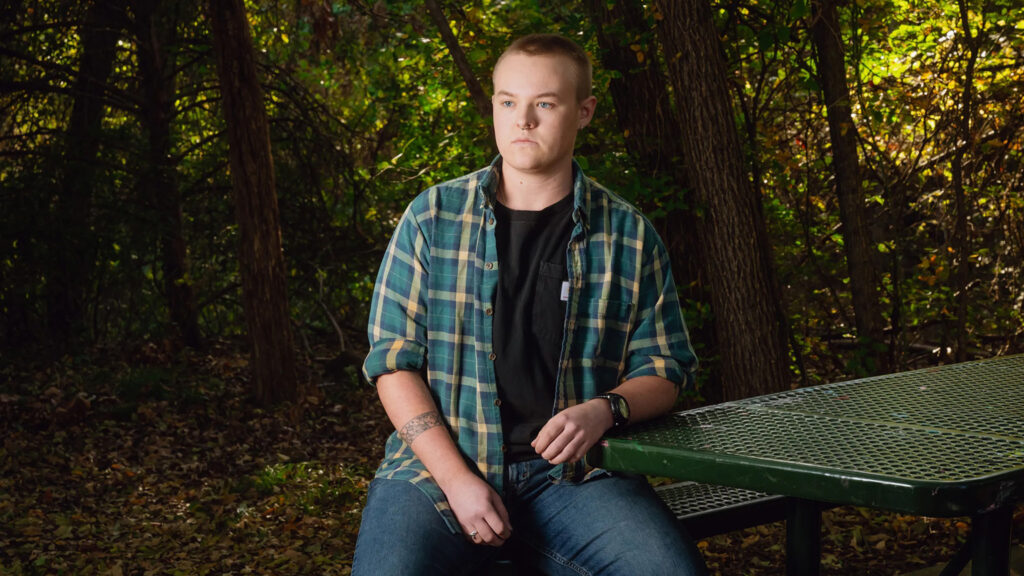
On Thursday, a new state law will add another layer of anxiety to Simon Shepherd’s already busy life: he has to worry — even more so than usual — about going to the bathroom.
It’s not an entirely new concern, said Shepherd, a transgender man living in North Texas. He had a similar issue in high school, he said, when school administrators asked that he use the girl’s restroom until they eventually allowed him to use the boy’s restroom amid legal pushback. But that was almost 8 years before Senate Bill 8, which is designed to prevent trans people like him from using certain state-owned facilities matching their identifying gender.
Supporters of the law claim it will make public facilities safer, mostly for women. How state agencies and schools will enforce SB 8 when it takes effect, however, is still unclear, as the language of the law lacks specific guidance on what policies or practices institutions should use. And while Texas is not the first to implement a bathroom bill, it contains vague guidance for agencies while simultaneously applying some of the highest fines in the country to those that fail to enforce the new law.
That confusion, which opponents of the law have said is intentional, has made Shepherd and others more frustrated than afraid as they seek to navigate their daily lives when SB 8 goes into effect.
“It is a scary concept to know that every single time I go to the bathroom at the university that I’m paying to be at, to get an education to better my life and the environment around me, [I’m] breaking a law that has been fearmongered and made to scare transgender individuals out of the public,” Shepherd said.
Commonly referred to as a “bathroom bill,” SB 8 places Texas alongside 19 other states with some form of legal restriction on restrooms in schools or public buildings. Shepherd said he’ll likely feel the effects of SB 8 the most at the university he goes to, which he asked The Texas Tribune not to name out of fear for his safety. But SB 8 doesn’t just apply to universities — it also places restrictions on restrooms in public schools, city halls and state agency buildings.
Regardless, his anxiety won’t change what restroom he’ll be using once the law takes effect on Thursday, he said, even if it goes against the new law.
“A lot of the folks that I have in my daily life and the sphere around me, we all agree we’re going to continue on as normal,” Shepherd said. “I understand that that is breaking a law, however, I will not bend the knee on that one.”
The enforcement question
There is little information or evidence of other bathroom bills being meaningfully enforced by other states, said Shannon Minter, vice president of legal for the National Center for LGBTQ Rights. In Florida, where violating their bathroom bill carries criminal penalties, a trans woman was arrested in April, but charges against her were never filed. The lack of precedent gives Texas institutions less context on what policies can be implemented and are designed instead to scare people into compliance, Minter said.
“They’re largely as a practical matter, unenforceable,” he said. “They’re almost never enforced. They’re simply designed to intimidate and scare transgender people.”
The Tribune asked several public agencies and university systems about potential policy changes in response to SB 8. Some state agencies said they plan on making no changes at all, because they believe their agencies already follow the law. A spokesperson with the Texas Department of Transportation said it already complies with SB 8, but did not respond to questions as to what policies it had that meet compliance.
A Texas Department of Criminal Justice spokesperson said the agency has no policy updates to make in response to SB 8 for its staff or for the 1,750 trans inmates housed in its facilities. While SB 8 has an additional requirement for prisons that states inmates must be housed according to their sex assigned at birth, TDCJ confirmed it already complies with the new rule.
Other institutions, like the Texas Health and Human Services Commission and the Texas Tech University System, said they are in the process of implementing the law’s requirements but did not share details. Many of the institutions the Tribune reached out to, including multiple cities, the Texas Education Agency and most of the state’s university systems, did not respond to questions about any changes being made in response to SB 8.
Supporters of the law have at times acknowledged the law’s absence of a policy mandate, but some proponents have said creating a policy would nevertheless be the best course of action. And there’s already a gold standard in the state to follow, said Mary Elizabeth Castle, director of government relations at Texas Values, a statewide nonprofit that has advocated for years for bathroom bills in the Texas Legislature. She pointed to Carroll Independent School District in Southlake, which in 2023 approved a district policy similar to what SB 8 now requires statewide.
“We do have examples in our state that municipalities, school districts can follow, and we think that it can definitely be enforced and followed and complied with,” Castle said.
A Carroll ISD spokesperson confirmed in a statement that the policy has been in place since July 2023 without major issues, but said they could not locate the policy to provide its specifics.
“Unfortunately, we have been unable to locate it so far,” a spokesperson with the district said. “Regardless, we have had no complaints, complications [or] challenges regarding this policy since its implementation.”
Castle said one caveat allowing easier enforcement at public schools is that most students have birth certificates or other identification on file, making it simpler to enforce the law. In public places like city buildings, workplaces at state agencies or university common areas, that documentation would not be readily available. The absence of that has added fuel to the fire to what often becomes the central question surrounding bathroom bills: how to ascertain who “belongs” in what restroom.
The author of SB 8, Sen. Mayes Middleton, R-Galveston, acknowledged during floor discussion in August that the law was designed to incentivize agencies to create policies in order to better comply. Middleton did not respond to multiple interview requests about SB 8 and his expectations for how the law should be enforced.
“What this does is create enforcement on the governmental entities that need to set these policies to separate men and women, male and female in private spaces, so it doesn’t create any new criminal penalties,” Middleton said during floor debate during the first special legislative session, when the bathroom bill was filed as Senate Bill 7. “It just creates an enforcement mechanism to do what’s right.”
“Passability politics”
Rep. Angelia Orr, SB 8’s House sponsor, said in a heated August committee hearing that enforcement would be based on how someone looks, though the Itasca Republican later walked back that assertion during floor discussion. Orr did not respond to multiple requests for comment about SB 8.
During that same public testimony and others, those opposed to bathroom bills frequently expressed concern that the lack of enforcement guidance could lead to state agencies requiring ID verification or physical inspections, which Middleton and supporters of the bill have denied. Many of those who spoke during testimony also worried that people may not understand which restrooms are actually affected by the law or who among them is trans, leading to public harassment of people regardless of their identity.
“The public generally is not clear on whether a law applies to public or private settings, so these laws just generally promote the kind of terrible mindset that encourages some people to feel that they’ve been deputized to question anyone’s gender,” Minter said.
The added public judgment is a twofold problem, said Stacey Monroe, a trans woman from Dallas and social activist. Among trans people, it ignites tense discussions of “passability politics,” or privilege for trans people who easily “pass” for their identifying gender. SB 8 creates a form of passability politics among cisgender people, too, she described, in that everyone will be under pressure to appear in a way that does not attract scrutiny.
“We’re starting to police not only trans and gender-expansive individuals, [but] also getting into how cisgender individuals will also be affected by this,” Monroe said. “They might be told, ‘You don’t meet this norm. You’re not woman enough, You’re not just feminine enough. You’re not what we deem as a society to be a woman.’ And so cisgender individuals will also, in this case, be harassed.”
Individuals can file complaints to the state attorney general’s office if they believe someone is in the wrong restroom, but false reports will be handled on a “policy by policy basis,” Orr said during floor debate on the bill. Castle said people should be able to trust “women and their instinct” for when complaints about who belongs in what restroom do happen.
“I believe that at the end of the day, it’s going to be about those examples where it’s very well known that something is not right and a woman felt uncomfortable,” Castle said. “And that the city outright is going to be responsible for setting a policy that they expect everyone to enter a social contract to follow.”
The end result of the law is that everyone will feel uncomfortable, Shepherd said. He and other trans people will be pushed into bathrooms that don’t match who they are, and cisgender people will be made uncomfortable by having people of the opposite gender in their bathrooms.
“That’s something I think that is inherently more surface-level scary,” Shepherd said. “Not because there’s a transgender person, period, in a bathroom, but because to your daughter and to the rest of the world and to myself, I’m a man, and now you want to put me in there just because of something that was originally on my birth certificate.”
Reluctant fighters
A handful of bathroom bills, including SB 8, allow the state Attorney General’s office or similar body to investigate agencies that receive complaints of noncompliance. Paxton’s office will have final say over whether a fine should be levied against institutions who receive complaints and how much any proposed fines would cost. Agencies will have 15 days after its first violation to address any issues and avoid the first-time $25,000 fee, but would lose that grace period for future complaints if a court finds them liable.
There have been few examples of state investigations sparked by bathroom bills elsewhere. But in Texas, Attorney General Ken Paxton has become known for regularly launching investigations into schools, hospitals and sports clubs because of their policies on trans people — often the precursor to lawsuits — long before SB 8’s passage. Those have come as Texas has passed other laws throughout the last decade, restricting transgender athletes’ ability to play on certain teams and criminalizing youth transition care.
Emmett Schelling, president of the Transgender Education Network of Texas, has embarked on a statewide tour through the fall to get in touch with trans people. He said all of those policies, including SB 8, have created an air of anxiety not triggered by any one law.
“I think there hasn’t necessarily been any particular policy that people are super-focused on as much as feeling an overwhelm of all of these policies that were passed, unfortunately,” Schelling said.
The biennial pushes at the Texas Capitol against trans people have been exhausting, Shepherd, Schelling and Monroe all said, but it’s done something else, too: it’s made them somewhat reluctant fighters, as Shepherd called it. All of them call Texas home, and although they are concerned about the new law, none have any plans on leaving.
“I’m very proud of the things I’ve done, but at the same time, I’m just a person trying to live my life,” Shepherd said. “At the end of the day, I’m just trying to go pee in the bathroom.”
Disclosure: The Texas Tech University System has been a financial supporter of The Texas Tribune, a nonprofit, nonpartisan news organization that is funded in part by donations from members, foundations and corporate sponsors. Financial supporters play no role in the Tribune’s journalism. Find a complete list of them here.
This article first appeared on The Texas Tribune.