
Indigo Girls’ Emily Saliers Talks Texas, Activism, and Barbie
Emily Saliers on 40 years with Amy Ray and their Sugar Land show.

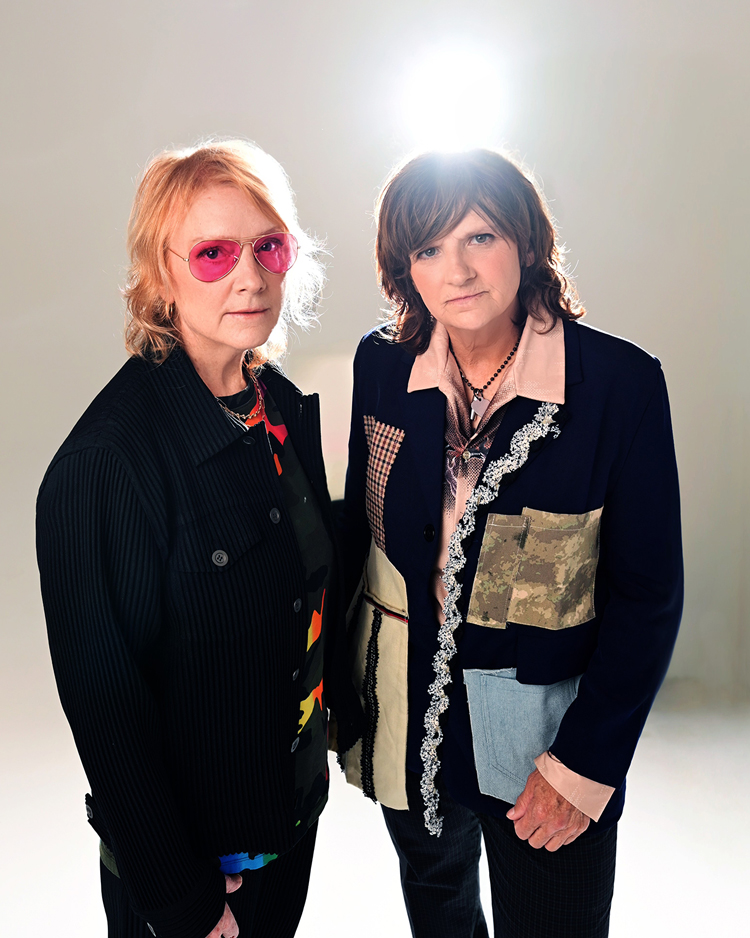
Amy Ray and Emily Saliers began making music together in 1981, while still in high school in Decatur, Georgia. After performing under “The B-Band” and “Saliers and Ray,” they searched a dictionary for a “cool” word and, in 1985, became “Indigo Girls.” More than 40 years later, the duo remains a beloved icon in the LGBTQ community and a music legend.
Over the course of their career, Indigo Girls has released 16 studio albums, earned seven Grammy nominations, and won the 1990 award for Best Contemporary Folk Recording for their self-titled album. Their catalog includes an estimated 200 original songs, among them “Closer to Fine,” “Galileo,” “Shame on You,” and “Least Complicated.”
Their music has also found new audiences on screen. In the summer of 2023, Margot Robbie and Ryan Gosling sang “Closer to Fine” while escaping doll land in a pink Corvette in the pop hit film Barbie. The following year, Ray and Saliers made cameo appearances in Glitter & Doom, a dreamy queer romance built around their songs, and Netflix released their wide-ranging documentary about the duo, It’s Only Life After All.
Indigo Girls 2026 Tour arrives in the Houston area on Thursday, October 15, at 7 p.m. at Smart Financial Centre in Sugar Land, with singer-songwriter and former 4 Non Blondes frontwoman Linda Perry as their special guest.
Ahead of the performance, Saliers spoke with OutSmart about their remarkable four-decade career, their enduring creative partnership, and the activist causes that continue to inspire them.
OutSmart: Amy’s writing is often described as having a raw, punk-infused energy, while yours leans toward intricate melodic folk. How do you keep those distinct sonic identities sharp while still maintaining that cohesive Indigo Girls sound?
Emily Saliers: We have a deep appreciation and enjoyment of each other’s songs. We really enjoy performing each other’s songs. I always think of it as if I were just in a band, I would be so bored with myself. So whatever Amy brings to the table musically, it’s the differences that hopefully allow for a wider breadth of musical experience for an Indigo Girls listener.
I know a lot of Amy’s raw sort of rock and roll approach—it doesn’t always come out in my songwriting, but there’s a sensibility that I’m inspired by in her. There’s never been an issue with us accommodating both of our sensibilities within our body of work. If we do a straight-out rock and roll song of Amy’s and I get to play electric guitar on it live, it’s very liberating for me. Whatever it is that Amy adds to my songs, it elevates them. So, we have trust in our process.
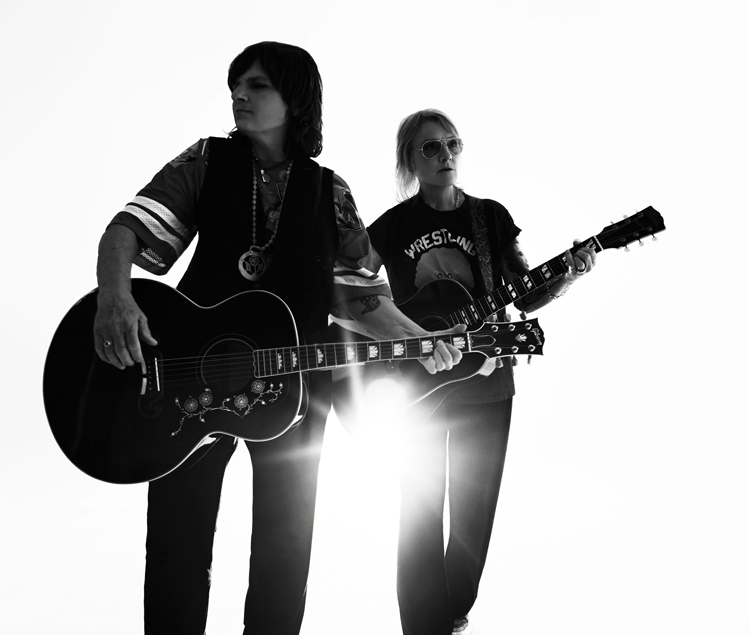
Passing 40 years of making music together is a rare feat for any band. What’s your unwritten rule or boundary in your partnership that you feel has kept your relationship healthy and creative for so long?
We have a rule that whoever says “I just can’t do this” or “I don’t want to do this” or “I need a break” or “I can’t tour during that time”—whoever has a strong feeling or a want or a need, we respect that above all else. There are times when we can agree to disagree. But after all these years, we have profound respect for each other’s individual personal lives and needs.
Amy writes her songs and I write my songs, and that has been key to our longevity. While we can’t write together, we can arrange together very creatively. We’re just so different. It’s almost comical at this point. We recognize she’s gonna be red and I’m gonna be green, and vice versa. It’s just a total yin-yang cohesion for us.
We’re not the kind of friends where we hang out together. We don’t get on the phone and chit-chat with each other. We have our own space. We don’t like to stay in the same hall in the hotel. We don’t like to sit next to each other on a plane. We need our own space, and that is not disturbing to me or Amy at all. We come together for our activism and our creative endeavors, and then we live our own lives, which are very separate from each other.
You’ve championed Indigenous rights, LGBTQ equality, and environmentalism since the beginning of your career. Has there been a price to pay for that activism?
Not a price that we wouldn’t pay a million times over. When we were out gay artists, the most important thing was to be out and part of the movement for our rights as LGBTQ+ community members. I think that we got pigeonholed as lesbians with acoustic guitars, and that the record company had trouble trying to find an image for us because we didn’t have one and we didn’t want one. There was a lot of homophobia and people put us in a box, but none of that was important.
There were times when things may have hurt our feelings or our wings were clipped in one way or another, but we’ve always been on our own trajectory with our own values and our own activism. The most important thing was to give credit and gratitude to those whose shoulders we stand on, and then to give credit and gratitude to the youth who are going to take things even further than we did. So, any sacrifices that we made professionally? They’re not even worth mentioning.
John Blizzard was a particularly important person in both of your lives. Who was he, and how did his influence shape each of you?
John Blizzard was an incredible human being. We got to know him because he managed a place called the Little Five Points Pub in Atlanta, which is where Amy and I cut our teeth when we were super young. We became the bar band at the club. John was a gay man who was an AIDS activist. He eventually passed away from AIDS. He was a man who encouraged all the different walks of life within the community.
The bar was a motley crew of humanity: all of us playing music together, joining each other on stage, all different kinds of musicians, different genres, different identities. John Blizzard was like the gathering and connective force for all of us. Just a critically important person to us, not only professionally but in developing our activism and in developing our commitment to community.
You came out publicly in the early 1990s, when doing so carried an immense career risk. When you look out at the landscape today for young queer and non-binary musicians, what makes you most proud, and what still concerns you?
There’s a terrible backlash now against us queers. Before I think about the music community, I think about teachers. I think about what’s happened in Georgia when a teacher loses her job because she reads a book about an LGBTQ+ character. We’re at the point again where we have a trans teacher and there’s a national uproar. We’re in this because of Trump, his administration, the lackeys in his regime, and the spineless conservative politicians who are only concerned with keeping their power. It’s a toxic and dangerous environment for queer people again. Not only that, but for people of color, and now with ICE and the immigration onslaught.
In the meantime, there are a lot of young queer artists I come across on my Instagram feed. They’re very out. They’re very inspiring. They’re very open. Right now, my favorite band is MUNA. Those people are fierce queer activists, queer musicians, queer content. They are completely comfortable in their identities and their activism and their music and their politics. I fear less for queer artists than I do for queer allies in education and public life and politics.
Your audience has evolved from college bars in Georgia to multi-generational festival crowds. When you look out from the stage these days, what do you notice about the energy or the makeup of the crowd?
The last show we did, there was a young woman with a sign that said, “I’ve got an Indigo Girls tattoo!” and I was just overjoyed at that. First, I like tattoos. Second, here’s this young person and I just wanted to say, “Where’d you come from?” There’s a lot of middle-agers who’ve been with us from the beginning. But now there’s quite a mix of particularly young women and gender queer folks, and it makes us so happy, because there is nothing better to me than inter-generational representation. I’m always like, “How did these younger people find our music?” It’s very gratifying to think that they can relate to it.
Our demographic has become younger, and a lot more boys and men in the audience. We have moved past that chasm between the gay men’s world and the lesbian world. Now so many bridges have been built.
Thanks to the Barbie movie, “Closer to Fine” introduced your music to an entirely new and younger generation. What was it like seeing a song you wrote decades ago suddenly become a modern cultural touchstone again?
It came out of nowhere. When our manager first said, “Hey, listen to this!” we were like, “Barbie what?” Question marks and exclamation points! Then we found out that Greta Gerwig directed it, and we’re like, “Ah, okay. We’re in no matter what they want.” We thought this song was gonna be in the trailer but had no idea it was gonna be in the movie.
I saw that movie the day it was released. I was in the Faroe Islands on vacation and saw it with Danish subtitles. I was levitating out of my seat with excitement because of the way the song functioned in the movie. I thought it was excellent—thought-provoking and so brilliantly stylized in terms of its color and the dancing and the whole thing. Then our monthly listeners on Spotify just shot up. It was like, what the hell? It put a lot of people in touch with our music who didn’t know that we existed, and that was really exciting.
Is there a message of hope you can share with transgender teens in Texas today who are navigating some intense right-wing attacks?
I would say that in these times, because of the burden and the weight and the sheer visceral oppression that you’re experiencing, there are many more people in this country and in the world who love and support you. Change is long and hard, and some people suffer much worse for it than others. We are working as allies and friends to change political realities, to work towards acceptance, love, joy, and happiness. We’re working for that for you, and if you can, just hang in there and take comfort in your supportive communities. We are totally behind you. Change will come.
Houston’s LGBTQ+ community is constantly under fire on the current political landscape, both nationally and statewide. When you bring your music to Texas in October, do you view your stage as a form of activist pushback, a sanctuary for the local community, or both?
Both, although probably more sanctuary for the local community. Texas is very tough for a lot of reasons, and my heart goes out to anyone in any minority community in Texas. So, when we come to Texas, it’s going to be very joyful, because we’re all in this together, and there’s a lot of straight folks who come to our shows who are allies and friends. It feels, just for a couple of hours, like this is the way the world could be when we join in, celebrating each other.
I remember we played a show in Texas when Trump was first elected, and it was visceral how badly we all needed each other. I know what’s happening in the press—about attacking James Talarico’s manhood and all this bullshit—and how terrible it is in the trans community, in the queer community, in the Black community, and in the immigrant community. It’s just fucking tough in Texas. But if you come to an Indigo Girls show, there’s a moment in time where it can be like: this is what it feels like when we’re all together. For any place where there’s particularly visceral and hateful attacks on minority communities, there is the joy of coming together. It is expansive and exponential.
WHAT: Indigo Girls 2026 Tour
WHEN: Thursday, October 15, 2026, at 7 p.m.
WHERE: Smart Financial Centre, 18111 Lexington Boulevard, Sugar Land
INFO: tinyurl.com/indigogirlsoutsmart