

Charli xcx Skewers Pop Fame in The Moment
Satire questions branding, art, and corporate control.


With brat summer, electronic-pop artist Charli xcx branded a pop culture moment with a signature color, an attitude, and a party girl spirit. With The Moment, Charli deconstructs this public persona and strong brand to parse both the existential uncertainty within the campaign itself as well as the fraught relationship between artistic integrity and corporate ownership.
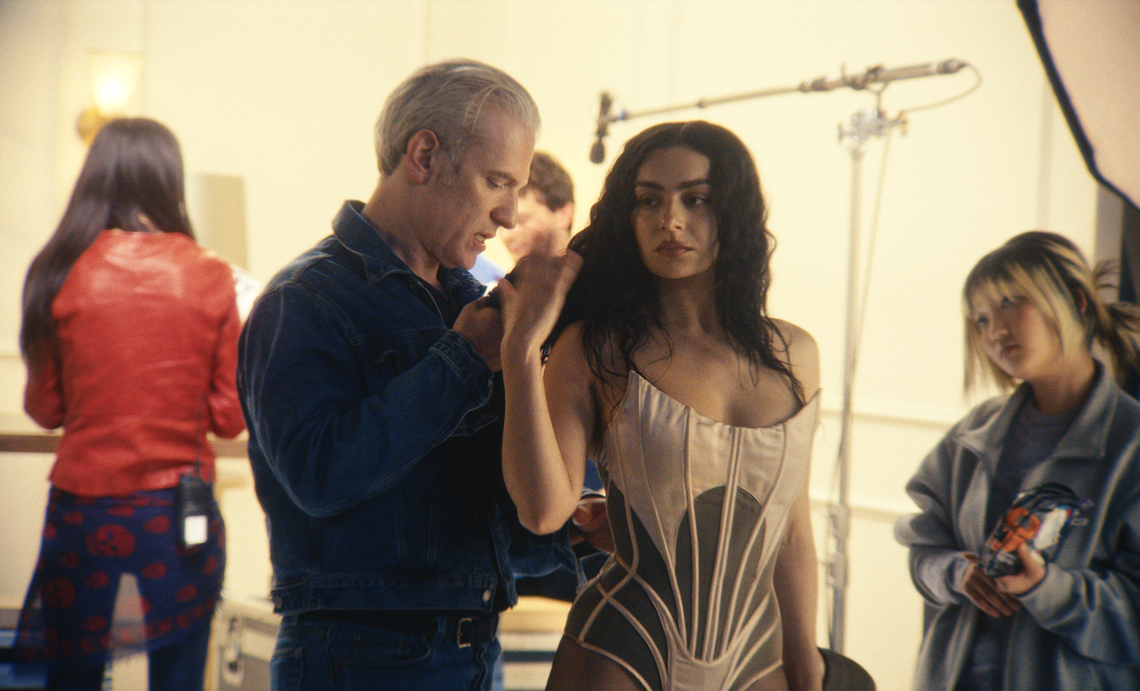
Based on an idea by Charli xcx, the satire follows the artist (playing herself) as she gets ready for her brat tour in September 2024 after the massive success of what was deemed brat summer and the sold-out SWEAT tour that helped launch the album. In preparation, the label wants to bring in major director Johannes (Alexander Skarsgård) to produce a concert documentary for Amazon Studios with the hope that brat summer can last “forever.”
There’s a clear divide between the creative team and the artist at the center, with Charli continuing her party lifestyle that’s been the focus of her artistry, while her friend Celeste (Hailey Benton Gates) acts as the creative director and main source of assurance for the singer. Tensions rise between Celeste and Johannes as priorities clash given the incompatibility between the conditions that created the album against what an Amazon Studios audience would want. As Celeste puts it, how do you make an album about cocaine family-friendly?
(Credit: Courtesy of A24)
For fans of Charli, this conflict between artistic integrity and commercialism isn’t new. Producing one of her worst-received albums, Crash, in the eyes of many Angels (the name given to her fans), brat was seen as a return to form—not just sonically, but in the persona Charli inhabits. There was a desire to see the cool girl Charli again—the one who wears sunglasses indoors because she’s recovering from an incredible night—not the highly choreographed pop star from her last era. Here, both personas are equally fickle.
The Moment is inseparable from the reality it’s mocking. Being on gay twitter in the summer of 2024 feels like a prerequisite. The film begins with the last track of brat, and it’s completely different but also still brat365 featuring shygirl, playing like the third in a trilogy following the two albums. While this excludes certain audiences, that accessibility would collapse the entire narrative. The ineffability of brat is core to this era of Charli xcx and part of the joke of the film: what is “brat?” It has as much comedic depth as a four-minute SNL sketch could allow, but director Aidan Zamiri and Charli adeptly decenter this question to instead focus on the capitalistic opportunity within that vagueness. If brat is a feeling, then it can be anything and commodified accordingly.
The label’s hope for the perpetual state of a brat summer equates to how long brat can continue to sell; whether that’s concert tickets, merch, or branded credit cards aimed at young gay people. This indefinability understands the life cycle of an artist based on their capital prospects. It’s a sharp departure from most recent musical biopics that always posit the central artist as the hero whose instincts need to be trusted by their label. It trickles down to the concerns of Charli herself, understanding that her voice and identity can be just as malleable as the label wants.
In a time where so many films center musicians as unbridled and misunderstood geniuses (A Complete Unknown and Bruce Springsteen: Deliver Me From Nowhere come to mind), it’s refreshing to see an artist tackle the anxieties of her own persona, especially when her personhood needs to constantly be performed or suppressed depending on the situation. It becomes a counter-narrative of sorts, ignoring the mythology of the visionary that record labels don’t trust and instead leaning into the uncertainties that artists face. How can an artist maintain authority when capital success is so critical to their reception?
Many music films obsess over the music’s creation rather than its reception, positioning the latter as inherent to the music’s quality rather than a condition of marketing. How are the musicians constructing their public profile, and what authority do they have in a larger studio system? It’s similar to Spice World or Josie and the Pussycats in the focus away from the creation of the music and more so on the talent’s almost ridiculous relationship to their fans and the company bankrolling their career. These questions of who defines an artist’s identity aren’t new, but with The Moment, it examines just how fragile this relationship can be.
It is, however, a minor film overall, lacking the humorous depth or truly biting critique to give a lasting impression. The satire that so resembles reality means that it plays it incredibly safe, with each beat more predictable than the last. Charli is more of a vehicle, a stand-in for herself, leaving an uncalculated performance for the material. The same applies to Zamiri’s overall direction of the film, wearing its inspirations so clearly that it loses any singularity to its form. It comes across as a proof of concept, potentially rushed to be released within the same marketability timeline it’s critiquing, rather than allowing itself to be developed into a multi-layered comedy.
While the surrounding elements leave much to be desired, the core concept is still key to the film itself. The closer Charli gets to success, the more opportunities there are for missteps, and that fear becomes completely overwhelming. So much of brat was praise for Charli revealing herself, giving fans and listeners more vulnerability than just being a party girl. But The Moment inverts this, showing just how fraudulent this performance can be.
The Moment is in theaters now.