
Shylah Salas Brings CHamoru Culture to Houston
The queer artist and business owner is creating space for Indigenous stories and community.

The International Day of the World’s Indigenous Peoples is celebrated each year on August 9. Established by the United Nations in 1994, the observance promotes awareness of Indigenous rights, cultures, and contributions.
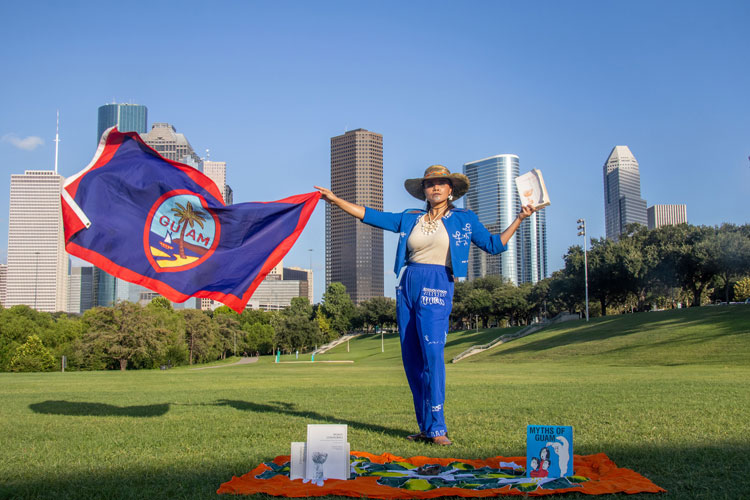
Shylah Salas, a queer Indigenous Pacific Islander woman, is a native of the tropical island of Guåhan (also known as Guam), an organized, unincorporated territory of the United States. The country’s name comes from a CHamoru word which means “we have,” signifying an island defined by an abundance of natural resources necessary to sustain life. Salas recently talked with OutSmart about her life as a Houston performance artist and small-business owner.
Before a serious accident in October 2022, Salas performed throughout the Houston area at community events and festivals, including the Houston Fringe Festival, where independent artists presented experimental and interdisciplinary performances in a cutting-edge environment.
Over the years, Salas explored theater, film, movement art, puppeteering, and dance in a wide variety of venues. An art form that resonates most deeply with her is the Japanese avant-garde art of Butoh, which she describes as “a cathartic, meditative, deeply expressive style of movement that allows one to embody stories that only the mind, body, heart, soul, and Mother Nature can tell.”
Salas still participates in Ecstatic Dance Houston, a weekly freestyle movement event at The Interchange. She also enjoys thrifting—piecing together outfits and costumes from recycled or thrifted material.
Salas owns Tribe Rides, a downtown transportation service that provides event shuttles and conducts tours of Downtown Houston that include sightseeing, mural tours, bar-hopping, and stories about the area. Guests often remember Tribe Rides for incorporating performance art through its “Tribal Space” (aliens) theme. “Kids and weirdos love it,” she says.
Salas also founded Humble Hustle Strategies, which helps music festivals and event organizers with creative concepts, shuttle services, experiential marketing, and vendor connections. The company exists “to connect humble hustlers (people with ingrained work ethics) and create opportunities for fellow underdogs to thrive.”
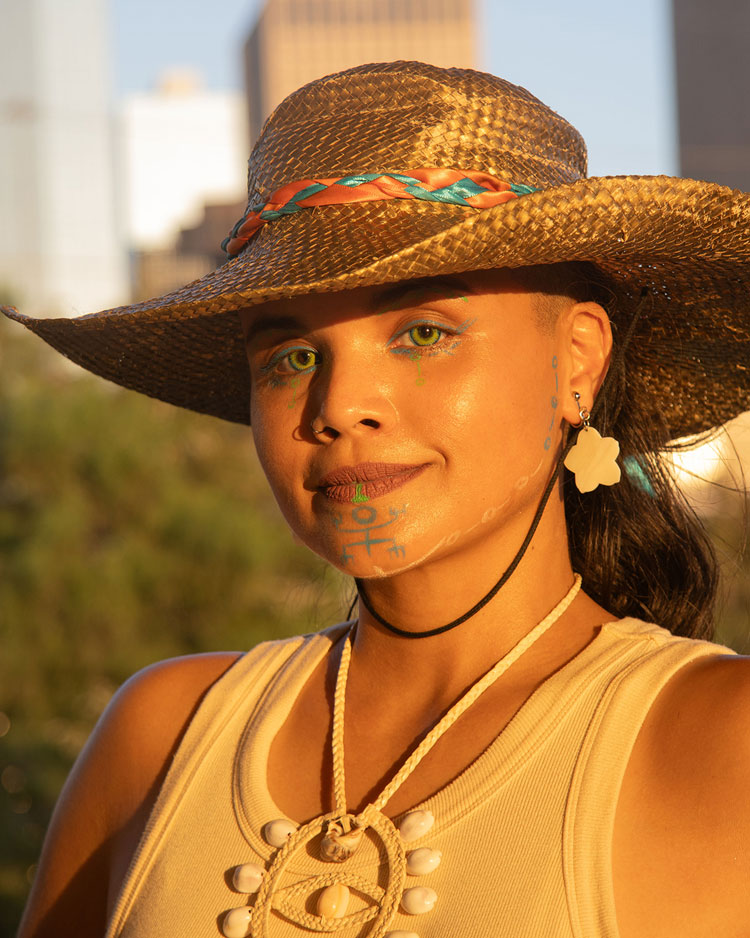
As a Chamorrita (a young CHamoru woman) and Houston artist, Salas says she did not always have a strong island community or many artists from her culture nearby. “So, I navigated through many hardships and challenged myself to build those relationships—to the point where it happened organically.” Salas became the first Indigenous/Pacific Island model and brand ambassador with Houston’s Diverscity Clothing Company, and she operates the only CHamoru-owned business in Downtown and Central Houston.
“I make an effort to stay informed about current events back home and continue paving ways to stay connected to our culture. I try to represent Guam and the Commonwealth of the Northern Mariana Islands with pride, humility, fierceness, and a willingness to keep learning,” she says.
A compassionate person by nature, Salas is also involved as a search and rescue volunteer. She did a considerable amount of animal rescue and disaster relief when Hurricane Laura ravaged Lake Charles, Louisiana.
Salas spent her early years in Guam with her younger sister. Her mother, a flight attendant, earned a college degree while raising her children as a single mother. Salas grew up in a family of educators and athletes; her grandfather, a retired policeman, still tends his ranch. “I’m grateful for the discipline they taught me,” she says.
An incredibly shy child, Salas found happiness in soccer and basketball, two sports she excelled at. She briefly tried Taekwondo at age 6. “But I was too shy to kick another kid,” she laughs.
Her formative years included several moves to and around the mainland beginning in fifth grade, each bringing challenges, including bullying. “I encountered racism at an early age. No matter where we moved, it existed. If there are no kids that look like you or are like you, you’ll feel obligated to adopt characteristics from the people you feel accepted by, just to blend in,” she remembers. “I learned adaptability and the importance of resilience.”
By eighth grade, the family was back in Guam, where she attended Simon Sanchez High School and enjoyed some of the happiest years of her early life. Her senior year was spent in Houston. In the classroom, Salas gravitated to language arts/English, art, physics, and history.
But it was sports that became central to Salas’ identity in high school. She competed in volleyball, rugby, basketball, cross country, and soccer; earned awards; appeared often in a local newspaper; and was invited to try out for a NCAA Division III program.
Athleticism ran in the family. Salas’ mother was an all-star athlete in Guam, and her grandmother was a well-known marathon runner who now volunteers for the Guam Running Club.
Salas says the biggest influence on her creativity was her “Papa,” Kenneth Hotaling, a retired Air Force serviceman and high-school history teacher who nurtured her love of music and theater. “Encouraging a child’s imagination and simply playing with them, expands their creativity almost infinitely,” she reminisces. She later attended Houston’s Lone Star Community College, taking a variety of courses and developing a special love for theater arts.
Proud of her heritage, Salas says the history of the CHamoru people spans thousands of years, rooted in their “familian” (family clan)—seafaring people with a deep connection to their land, oceans, and Taotaomo’na (ancestors). CHamoru culture is also known for weaving, carving, fishing, pottery, outrigger canoe-building, and the ancient latte stone—limestone pillars unique to the Mariana Islands that supported traditional homes and remain symbols of strength, ingenuity, and resilience. The stones are celebrated in the Latte Stone Park in Hagåtña, Guam, a Stonehenge-like tourist destination.
“Despite centuries of colonization by Spain, the United States, and Japan during World War II, many communities continue to preserve and celebrate our dying language, cultural arts, and traditions,” Salas notes.
Salas says she never had a traditional coming-out story. Instead, during a disagreement, her little sister outed Salas to their mother. “She ripped the band-aid off! She made it easier,” she now laughs.
When Salas thinks of unsung heroes within the Asian American Pacific Islander queer diaspora, she thinks of people and organizations who protect their communities. One that inspires her is Prutehi Guåhan, a community-based group dedicated to protecting Guam’s land, culture, and ancestral history. “Monaeka Flores, a Queer founding member of Prutehi Guåhan currently serves as the Executive director.”
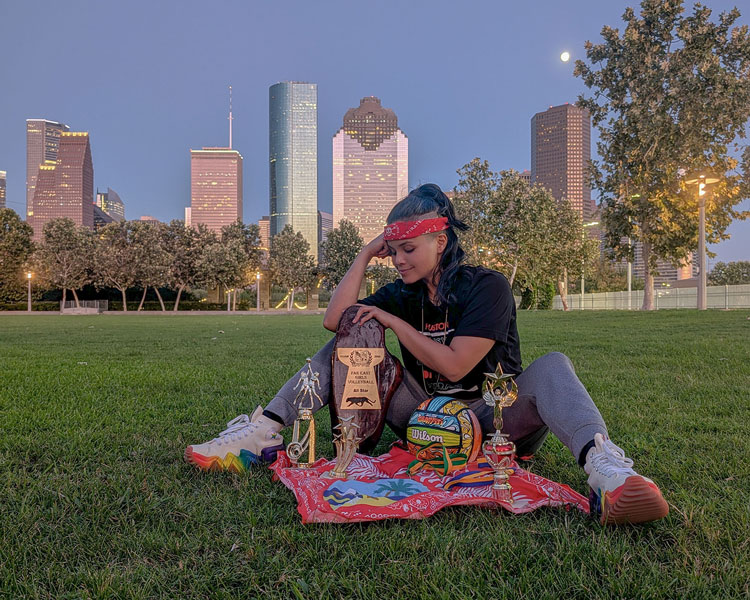 Another member of the queer community who has impacted Salas’ life is Kayla Morrell. “She exceeds the expectations of friendship because she is more than that. She is a soul sister; she’s Shylah’s Ride or Die. Kayla is a hardworking corporate mother, a talented professional aerialist, and one of the most dedicated artists I know. Her consistency, passion, and fortitude deserve to be celebrated. When you have a chance, catch her performing with Cai Circus.”
Salas was also influenced by Ivan Espinosa, founder and Executive Producer of the Salish Sea Butoh Festival. “Ivan introduced Butoh to Houston—a cathartic, existential experience that completely impacted my life and my relationship with art. He continues to create opportunities for diverse artists to connect and share their work. He is currently a professor at the University of Colorado Boulder, an ambitiously educated individual, mentor, and established artistic director. Because of Ivan, I was the first CHamoru to perform and share their culture at the Salish Sea Butoh Festival.”
Additionally, Salas credits behavioral therapist Nakita “Coach Kita” Bowman (2025 Pride Houston 365 Gender Non-Binary Grand Marshal) who continues to refer both artistic and entrepreneurial invitations to her.
For Salas, entrepreneurship, art, and culture are often connected. “Each category influenced my inspiration for the other. My business creates opportunities, my art tells stories, and my Pacific heritage reminds me why representation and community matter. Whether I’m assisting with an event, performing, or networking, my goal is the same: to bring people together and create opportunities for our fellow underdogs to be seen. You can only be the lone wolf for so long. Ultimately, you’ll miss feeling part of a tribe.”
During a dark time in America when inclusion is discredited, Salas says, “Diversity is what gives the United States its character because our country is built from the stories, cultures, and experiences of a melting pot of backgrounds. Indigenous history should not be erased because these stories are the foundation of this land, to help us understand where the United States of America comes from. Honoring Indigenous cultures isn’t about regressing; It is about honoring the people, traditions, and ancestral knowledge that have survived generations, most significantly, continue to influence the future we are building together.”
To cope with the current anti-LGBTQ atmosphere, Salas finds hope in therapy, trusted friends, political humor, and balancing awareness of difficult realities with breaks from the news. With a sense of humor, she says she also closes her eyes and imagines being with loved ones, living as the fictional Na’vi in Pandora, in the hugely popular Avatar films.
Reflecting on her personal journey, Salas says that her story is “wholeheartedly about perseverance, recognizing your gifts, embracing the beauty of culture, and learning to fall in love with an infinite amount of knowledge in a finite amount of time.”
Representation matters to her. “I always think of the little kids who were like little Shylahs, very shy and nervous, but secretly ambitious. Be the representation that you didn’t get to see growing up. Be that for the little you’s out there.”