
Autumn Lauener Advocates for Trans Visibility and Collective Liberation
Houston activist connects disability justice, policy work, and community care.


When you ask Autumn Lauener to describe their work, they pause. Not because they don’t know, but because the answer runs deep.
“There’s this idea of collective liberation, the idea that none of us are free until all of us are free. And to me, that’s really the approach that I feel helps connect everything together.”
That through-line of collective liberation threads through everything Lauener does, from disability advocacy and transgender visibility to disaster preparedness, DEI and nondiscrimination policy work, and legislative testimony at the Texas Capitol. It’s also rooted in lived experience.
Growing up in Oklahoma, Lauener says, they were “definitely always one of the more intelligent kiddos,” in spite of sensory problems, anxiety, and struggles with social skills. As a student coping with schools becoming larger and less accommodating, “it really started getting overwhelming. I always felt like I should have been able to do more but couldn’t. It was just really frustrating not having the structural support in place.”
Eventually, they ended up dropping out of high school. That experience, “stuck with me in a way,” they admit.
Years later, Lauener graduated college with a cumulative 4.0 GPA across bachelor’s and master’s programs. “I think part of that was that chip that kind of stuck on my shoulder,” they reflect, “that vendetta of ‘No, I should have known these things. I don’t like that I ended up dropping out.’”
One aspect that helped Lauener through their college experiences was the ability to learn in different environments. More importantly, though, college also offered policy protections and the space to live authentically. “Having that protection was really one of the things that helped to reassure me that it was safe to start going back to school,” they say.
That clarity shaped Lauener’s approach to social work. “If we have a system that’s causing harm to people, something that’s just spilling over and causing harm everywhere, usually some people are going behind it and trying to clean up,” they explain. “Conversely, the macro pieces are trying to stop the system causing that harm.”

In Houston, that macro lens includes disability-inclusive disaster preparedness. “Houston is kind of a perpetual disaster city,” Lauener notes. “Houston’s propensity for disasters, mixed with Texas’ very poor disability policy, all culminates together, and people just don’t have the support they need.”
For example, they describe power chairs failing in floodwaters and the sensory overload of emergency shelters—situations where the lack of disability-inclusive disaster preparedness and support systems becomes inherently challenging.
“As an autistic person, sensory stuff can be really overwhelming,” Lauener points out. “Whenever you’re going into shelters during a disaster and it’s this huge stadium with all these noises, it’s total chaos. That’s enough for anybody, but when you add in those extra sensory pieces like communication and differing rates of processing your environment, it really becomes problematic.”
One initiative Lauener values is a simplified disaster preparedness kit for people with intellectual disabilities and low reading levels. “It helps with having that preparedness ready to go,” they say. But good preparation doesn’t always happen, often because people assume someone else will step in.
As an advocate, Lauener testified at the Texas Capitol 17 times during the 89th Legislative Session. The first time, in the Senate chamber, “was hugely intimidating—like trying to take a cup of water out of the ocean, in an attempt to try and drain it.”
Still, Lauener kept showing up. “The laws that you’re passing don’t change who we are as people,” they proudly told legislators.
For Lauener, meaningful allyship requires action. “Everybody has some level of privilege,” they say. True solidarity is “that point of going from ally to co-conspirator, risking something in terms of joining that fight.”
Recently, Lauener was honored with the Monica K. Roberts Trans Advocacy Award from the Houston LGBTQ+ Political Caucus. “That was really surreal, and still feels surreal in a way,” they say. “It was really incredible to be recognized by the community that way.”
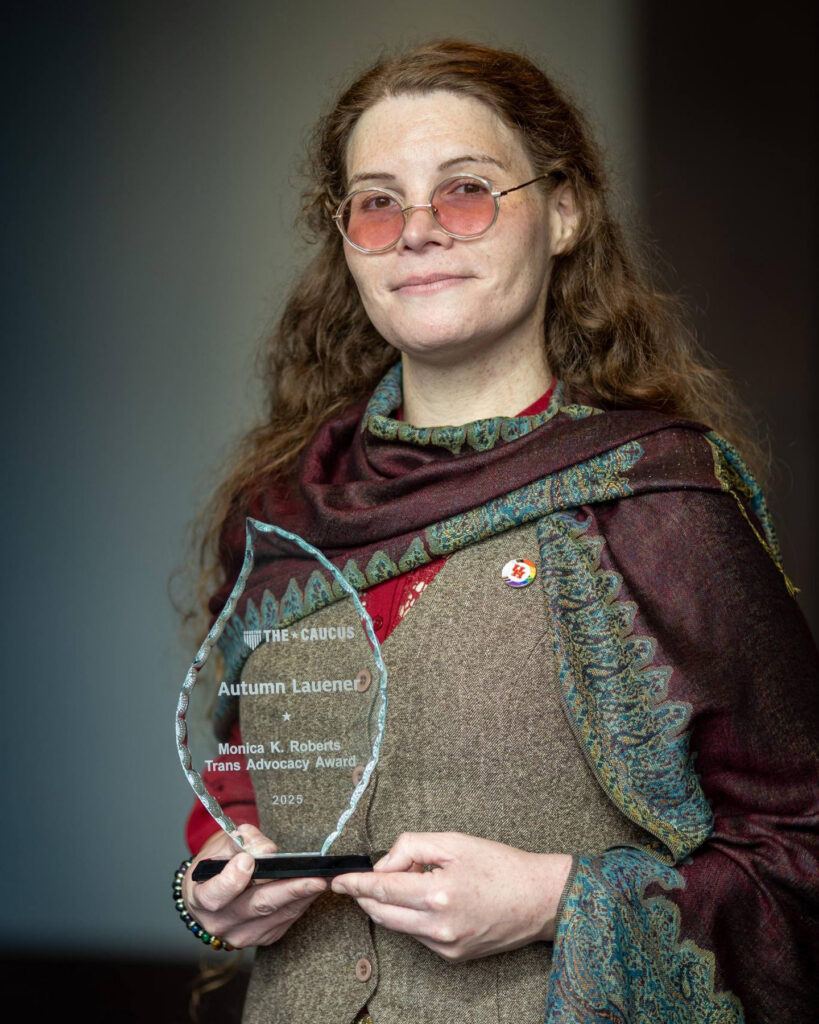
The award offered a valuable platform that allowed Lauener to say, “Hey, here’s what our community, especially trans people, are experiencing. Here’s what people want from you.”
Despite the awards and recognition, burnout is real. “I hit burnout pretty hard,” they admit. But they return to a line from The Lord of the Rings to provide the push they need to move forward. Early in The Fellowship of the Ring, Gandalf says, “All we have to decide is what to do with the time that is given us,” which Lauener interprets to mean “we don’t get to choose what happens. We only get to choose what we do with our time.”
For March 31’s International Transgender Day of Visibility, Lauener frames visibility as a mirror.
They recall “not really having anybody to look to growing up and not being able to say, ‘Oh, that’s somebody who I could see myself being.’”
Lauener acknowledges that they have the privilege to be visible, and that it allows them “to provide that mirror for people who might not be in a position to live how they want,” and who are searching for proof that it’s possible to live authentically.
“I can be who I want to be.”